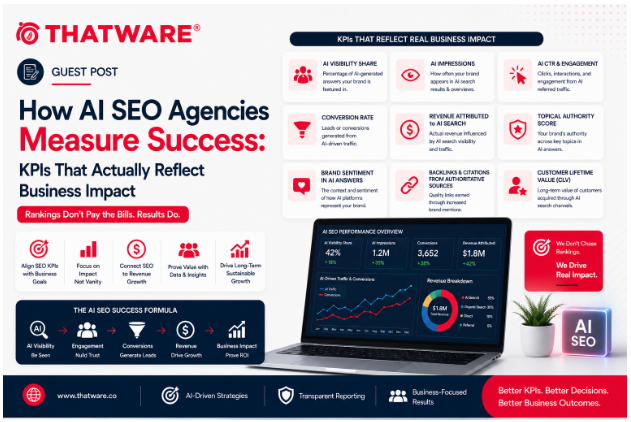
Metrics are where SEO accountability goes to hide. It’s a cynical thing to say but it’s often true. An agency produces a monthly report full of numbers that are trending in the right direction — impressions up, rankings improving, domain authority growing — and the client feels like things are working. Until they actually look at what changed in their business and realize they can’t connect those numbers to anything that matters.
This is a persistent problem in traditional SEO. In AI-era SEO, it’s potentially worse because the landscape is newer, the measurement frameworks are less established, and there are even more opportunities to report on interesting-looking metrics that don’t actually reflect business impact.
What follows is an honest guide to what meaningful AI SEO measurement looks like — what to track, what to ignore, and how to hold an agency genuinely accountable for outcomes that matter.
The Problem With Traditional SEO Metrics in an AI World
Traditional SEO measurement was built around keyword rankings and organic traffic. Both still matter. But they’re incomplete in ways that have become more significant as AI search has grown.
Keyword rankings don’t capture AI Overview presence. If your content appears in a Google AI Overview for a high-value query, that might be more valuable than ranking #3 for that query in the traditional results — because AI Overview content gets seen by users even if they don’t click. But it won’t show up in your rank tracker.
Organic traffic figures are being disrupted by zero-click behavior. When AI Overviews answer questions completely, users may not click through to any result. A brand that’s cited as a source in the AI Overview might be getting brand exposure and consideration without generating trackable clicks — traffic metrics would show nothing while something meaningful is actually happening.
And perhaps most importantly, neither traditional metric captures ChatGPT and other LLM citations at all. If a prospective customer asks ChatGPT to recommend vendors in your category and your brand gets mentioned — that’s meaningful visibility that exists entirely outside traditional SEO measurement.
What Meaningful AI SEO Measurement Actually Looks Like
A mature AI SEO measurement framework covers several distinct things.
AI Overview presence tracking. Systematic sampling of Google searches for target queries to identify when and how the brand appears in AI-generated summaries. Not just whether you appear, but how you’re described, what context surrounds the mention, and whether the description aligns with how you want to be positioned.
LLM citation analysis. Regular testing across ChatGPT, Perplexity, and other LLM-based search tools for relevant queries. Does the brand get mentioned when someone asks about solutions in your category? How does it compare to competitors? What’s changing over time?
Entity strength indicators. Measures that reflect how well AI systems understand and categorize your brand: Knowledge Panel presence and completeness, structured data validation results, consistency of brand entity signals across authoritative sources.
Traditional metrics where they still add signal: organic traffic from non-branded queries (which still indicates real discovery), conversion rate from organic traffic (which indicates quality of the visitors being attracted), and ranking trends for queries where AI Overviews haven’t taken over.
Connecting Metrics to Business Outcomes
The top AI SEO experts don’t just report on search metrics in isolation — they build the connection between search visibility and actual business outcomes. This is harder but it’s where the real accountability lives.
What does this look like in practice? A few approaches that work:
Traffic quality analysis. Not just how much organic traffic, but what that traffic does. Do organic visitors from AI-era search have higher engagement rates, longer sessions, better conversion rates than traffic from other channels? If your content is reaching the right people — people who found you because AI systems cited you as an authoritative source — that quality should show up in behavior metrics.
Influence-path tracking. For longer sales cycles, trying to understand how organic and AI search interactions appear in the broader customer journey. This often requires attribution modeling that goes beyond last-touch — understanding how early-stage awareness generated through AI search eventually converts.
Brand search volume. If AI systems are citing your brand in answers, you’d expect brand search volume to grow over time as people hear about you through AI interactions and then look you up directly. This is a lagging indicator but a meaningful one.
Pipeline attribution. For B2B brands especially, asking new customers or leads how they first heard about the brand — and whether “found in AI search” or “saw you mentioned in ChatGPT” is a meaningful response category.
Reporting Cadences That Actually Work
Monthly reporting is standard but not always optimally structured. A few things that make reports genuinely useful rather than just regular.
Trend framing rather than point-in-time. A single month’s data is almost meaningless in SEO. Reporting should always show direction of travel — three-month or six-month trends — rather than comparing to last month only.
Narrative alongside numbers. What’s the story behind the numbers? If AI Overview appearances increased this quarter, why — what changed? If organic traffic dipped, what’s the explanation? Reports that just present numbers without interpretation aren’t actually helping the client make decisions.
Honest acknowledgment of what’s not working. The most trustworthy reports are the ones that include things that aren’t performing as expected alongside the things that are. Agencies that only report on positive numbers are optimizing for their own retention, not their client’s ability to make good decisions.
Setting KPIs Before the Engagement Starts
One of the most practical pieces of advice in AI SEO measurement is also the simplest: agree on KPIs before the engagement starts, not after. This seems obvious but it happens less often than it should.
Before signing with any agency, have a specific conversation about: what metrics will we track, how will we measure them, what does good look like at six months and at 12 months, and what would trigger a strategic review if results aren’t meeting expectations?
The best AI SEO services are delivered by agencies that are comfortable having this conversation upfront — that can articulate specific, measurable outcomes and commit to honest reporting against them. Agencies that hedge this conversation, that prefer to keep KPIs vague until after the contract is signed, are protecting themselves from accountability.
A Framework for Non-Technical Clients
For clients who don’t have deep SEO backgrounds, a simplified framework that captures what matters:
Are we showing up in AI answers for the questions our customers are asking? (AI Overview and LLM citation tracking)
Is our content attracting the kind of visitors who become customers? (Traffic quality and conversion metrics)
Is our brand becoming better recognized as an authority in our space? (Brand search volume, entity strength signals, third-party mentions)
Is the SEO investment contributing to business growth? (Pipeline and revenue attribution, even if imperfect)
These four questions aren’t technically complex. But they cut through the noise of vanity metrics and connect SEO activity to the business outcomes that actually matter.
ThatWare’s measurement approach is built specifically to answer these questions — connecting AI search visibility to real business impact rather than reporting on metrics for their own sake. Their approach at https://thatware.co/best-ai-seo-agency/ is worth examining as a model for what meaningful measurement looks like.
In the end, metrics are only valuable if they tell you whether the strategy is working and help you decide what to do next. Everything else is noise dressed up in a dashboard.
Seo